
Two IRB 6650S on one part
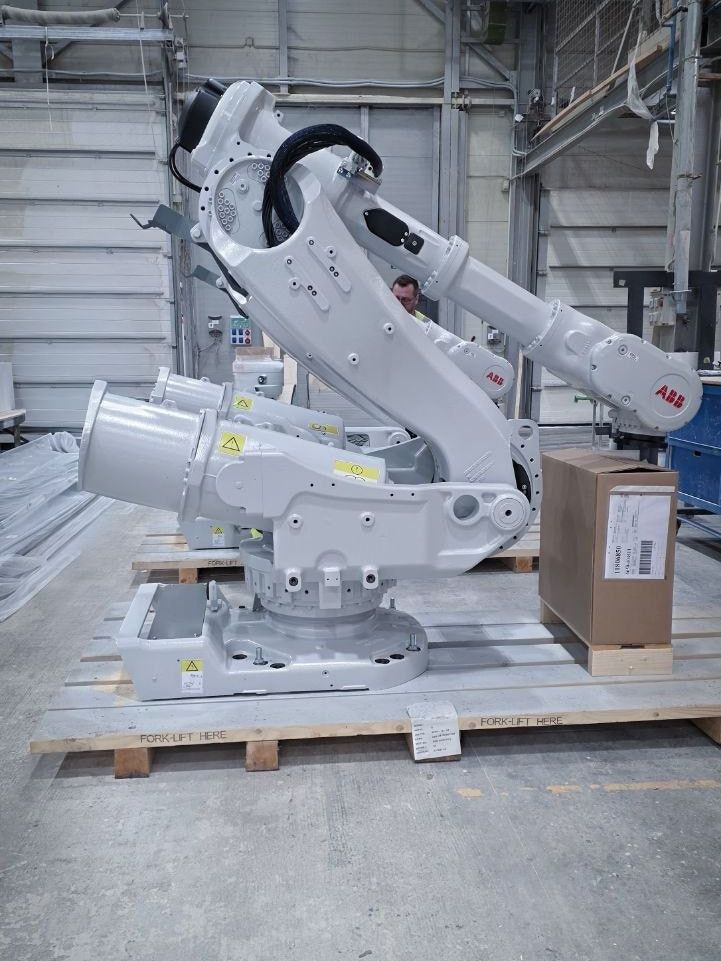
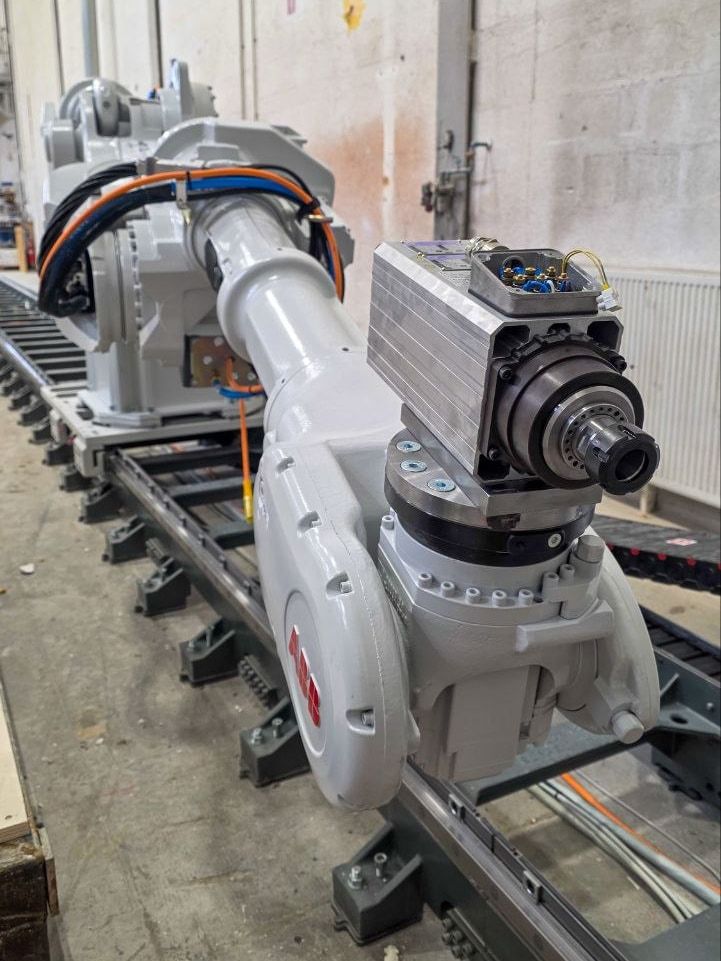
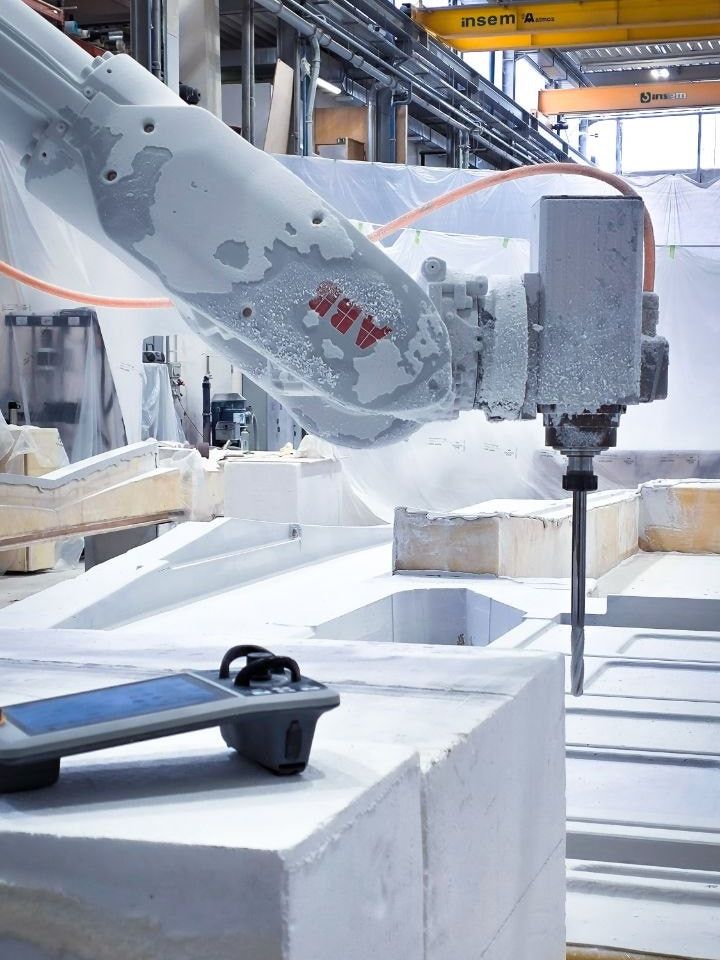
This is the cell the software was built for and against. Two ABB IRB 6650S-125/3.5 arms on IRBT 6004 tracks share one working area and mill plugs and tooling up to fifteen metres long. Everything on this site that is called proven was proven here first — on real machines, under power, with a real part on the floor.
- 2 × IRB 6650S-125/3.5
- IRBT 6004 track, ~19.7 m
- ABB IRC5 · RAPID
- Milling
- 13,081,290points solved
On the platform so far, and counting. Inverse kinematics with collision checking, solved in a browser tab.
- 381controller writes
Programs, offsets and corrections written to live controllers — every one sealed in a tamper-evident audit chain.
- ~100 sfull run
From imported toolpath to a finished export package.
- 15 mlongest part
Plugs milled across the shared working area of both arms.
What the cell is
Two IRB 6650S-125/3.5 arms, each on its own IRBT 6004 track with roughly 19.7 m of travel, facing each other across a common working area. The overlap is the whole point: a part longer than one robot can reach stays one part, and both arms work it instead of it being split into two jobs.
Both controllers are IRC5, and the product’s only live driver talks to them over RWS. The architecture itself is vendor-independent — the kinematic core is a pure function, the cell is described by a document, the robot arrives as a parameter — but what is proven in production is this: ABB IRC5, milling.
The job
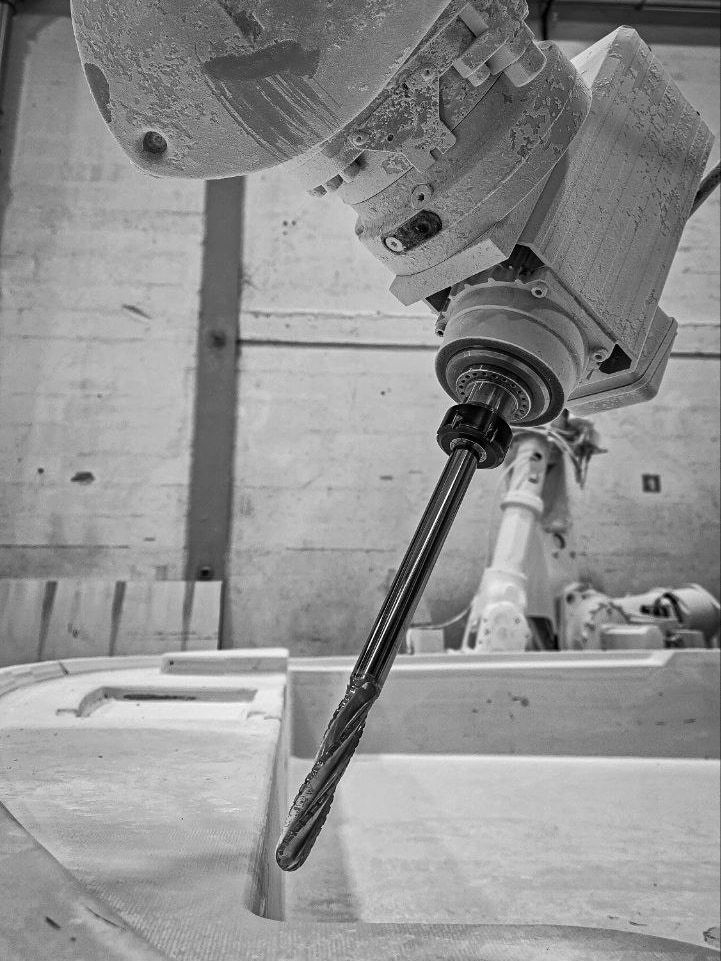
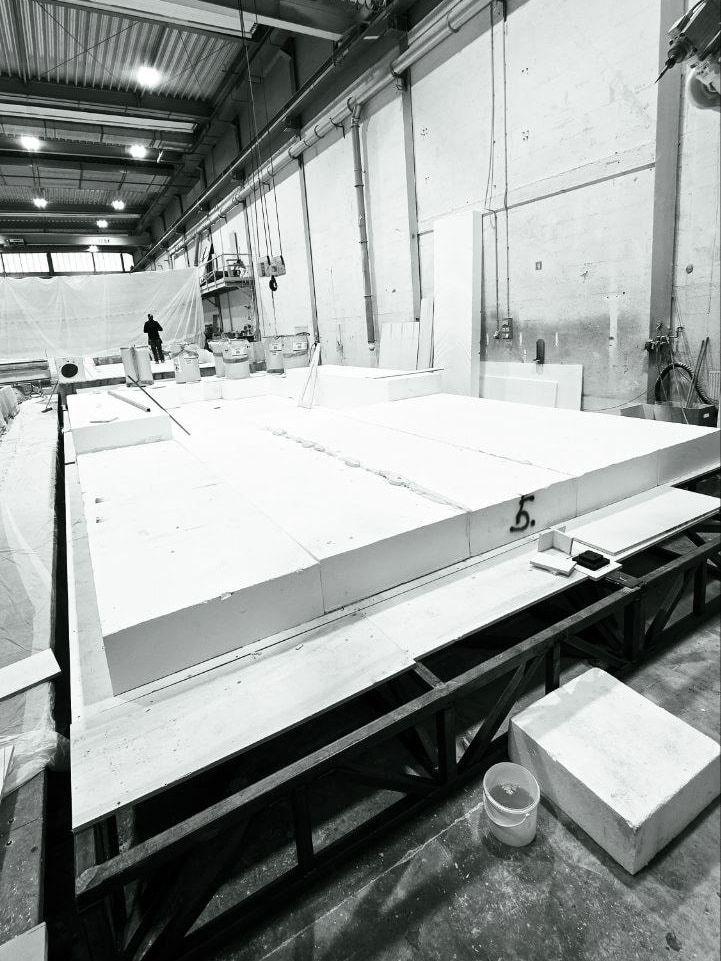
Milling plugs and tooling — the positive masters moulds are taken from — out of polyurethane foam, wood and composite. Long continuous contact paths, hundreds of thousands of points, and tolerances that depend on where the tool tip actually is rather than where the model says it should be.
The chain is the one described elsewhere on this site: CAD/CAM in Fusion 360, APT or G-code out, inverse kinematics with collision checking in the browser, RAPID out of the post-processor, the program uploaded to the controller, and live telemetry coming back while it runs.
What had to be solved
None of this was a feature on a roadmap. Each item is here because the cell did not work until it existed.
Two arms, one space
Robots that can reach the same volume can also reach each other. Each operator window draws its own robot plus a translucent ghost of the neighbour, and a proximity guard stops both without waiting for a person to notice. The emergency stop deliberately carries no token and does not depend on the internet: a blocked stop is a collision, an unauthorised stop is downtime, and those two costs are not the same.
Where the tool tip actually is
A spindle mounted by hand is never mounted where the drawing says. The TCP is calibrated from four points and stored per workstation. Get this wrong and all 118,417 points are wrong — by the same amount, and silently.
Where the part actually is
The part is probed against sketches taken from Fusion, and work objects are read from and written to the controller directly. Corrections travel the same way — nobody retypes coordinates by hand.
Paths nobody can hold in their head
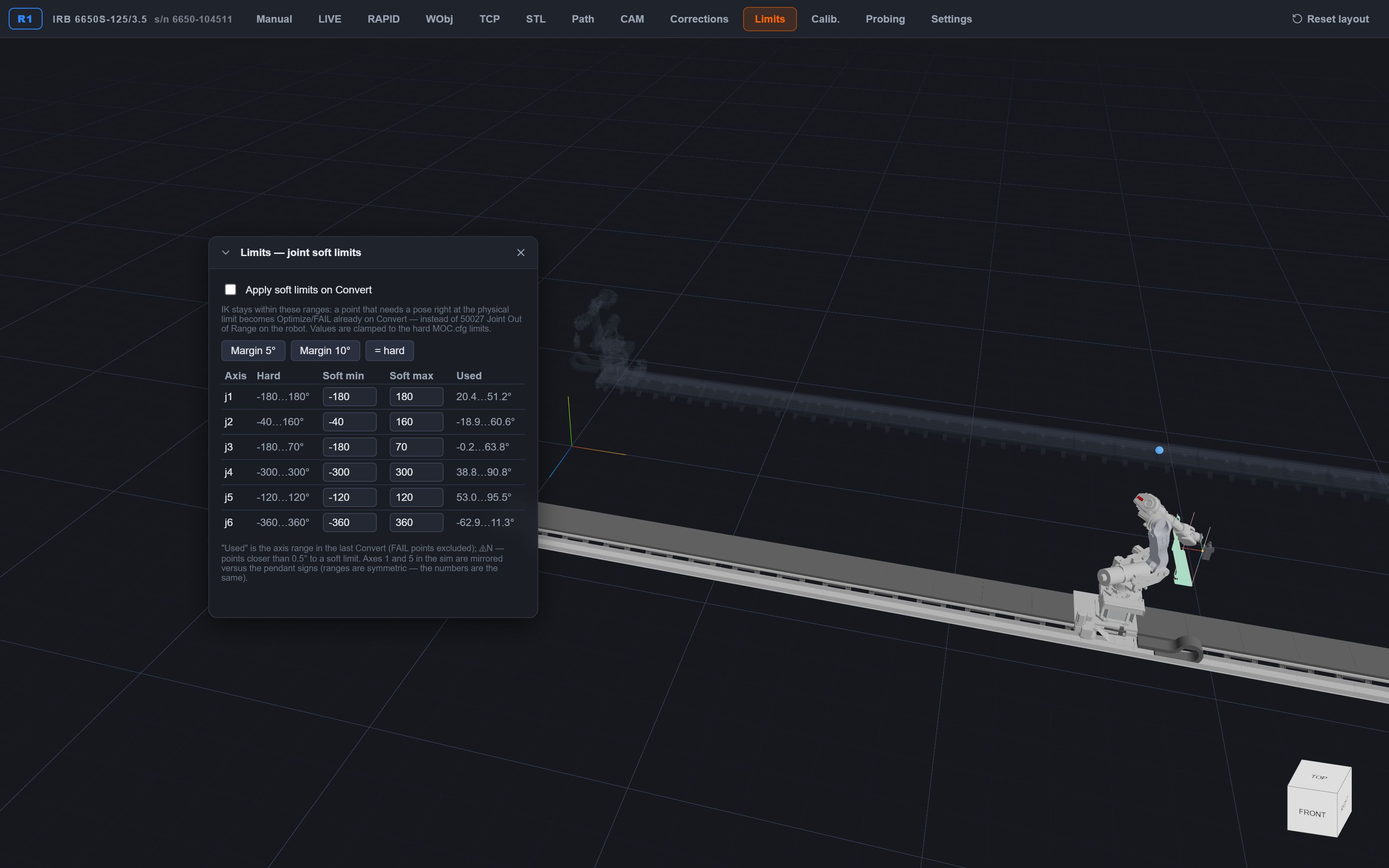
118,417 points in a single job. Soft axis limits turn a future controller error into a FAIL during conversion, so a program that would have stopped the machine mid-cut fails at the desk instead. Collision checking runs robot against robot and robot against part.
Knowing the cost before the spindle turns
Cycle time is estimated with the dynamics and the timeline scrubs, so the argument about whether a strategy is worth it happens before anything is cut.
The proximity guard today works pairwise, with one neighbour. Two robots at the same time is proven; three or more needs an all-pairs guard, and that is project work rather than something already on the shelf.
Where the numbers come from
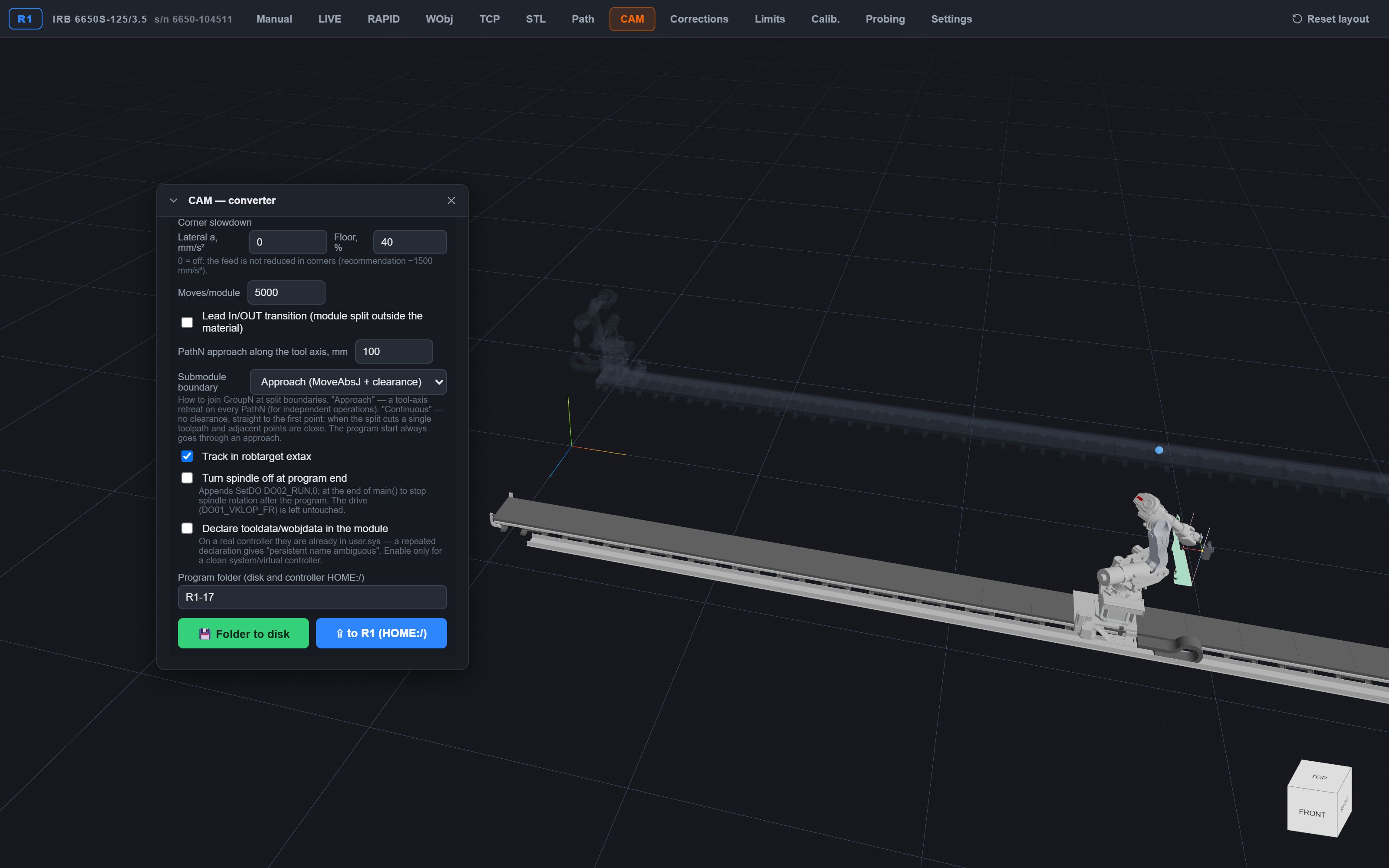
The same job was run twice: once entirely in the browser tab, once through the server pipeline — convert, then export RAPID. The result was 299 .mod modules compared byte by byte, with no differences. That comparison is the acceptance test for the whole chain, and it runs against a real sample job rather than a fixture.
A full run — import, solve, post-process, package — takes about 100 seconds. The application itself works standalone: opening a job, solving it and exporting it need neither a back end nor a bridge.
What moves to your cell — and what does not
Transfers as it is
- The kinematic core: inverse kinematics, collision checking, cycle time, the timeline.
- The cell document: roster of robots, frames, mounting on floor, track or pedestal.
- Multi-robot addressing, roles, short-lived tokens, the audit chain.
- The operator window in the browser — nothing installed on the shop-floor PC.
- The RAPID post-processor and the live IRC5 driver, if your controller is ABB.
- The bridge — on the shop-floor PC, or on a box next to the controller.
Calibrated for this cell only
- Base frames, track geometry and axis limits — read out of these two controllers’ backups.
- The TCP and the spindle mount — measured on this tooling.
- Work objects, probing sketches and feed strategies — tied to these parts.
- Robot geometry: the model library today holds the IRB 6650S. Another arm means adding its model, with a real risk of TCP drift until it is calibrated again.
- A post-processor and driver for a non-ABB controller — written within the project, not available off the shelf.
Stated plainly
- Milling is what is proven in production. Polishing, finishing, painting and large-format printing are the same class of continuous path and port closest; machine tending is a different class of motion and is quoted as such.
- Two robots working at the same time is proven. Three or more needs an all-pairs proximity guard — in scope of a project, not in stock.
- The simulator is an auxiliary engineering tool. It is not a safety function within the meaning of the Machinery Directive and does not replace the cell’s own safety systems.
- Batch collision checking walks the path with a stride, so a very short collision between two samples can go unnoticed. It is a filter, not a proof.
Does your cell look like this?
Tell us the robot, the part and the process. You get back what transfers as it is, what has to be measured on site, and what has to be written from scratch.
Tell us about your robot