Buying the arm is a purchase order. Getting it to run your part is a project — cell model, calibration, toolpaths, a post-processor for your controller, and an operator window your people can actually use. We do that project: for one robot, or for several working the same part at the same time.
move the cursor — both robots follow · drag to orbit
The gap
The arm arrives. The process does not.
The robot is installed, commissioned and reaches every point of its envelope — and still does not make your part.
The vendor package covers the machine, not the job: your geometry, your fixture, your tolerances, your changeover.
And there is nobody in-house who will write the post-processor, calibrate the tool and build a window the shop floor will actually use on a Monday morning.
That distance between a working robot and a working process is the project. It is the part we do.
CNC.HOUSE Studio
The software exists, and it runs a cell today
01
Cell model and calibration
Your cell described as a document: robots, tracks, mounts, tools and work objects. The tool centre point is calibrated from four measured points; work objects are read from the controller and written back to it. Measurement points come from sketches in your CAD.
02
Toolpaths with collision checking
APT or G-code in, solved joint motion out. Inverse kinematics with robot-to-robot and robot-to-part collision checking, soft axis limits that turn a future controller error into a FAIL during conversion, cycle-time estimation with dynamics, and a timeline you can scrub.
03
A post-processor for your controller
The current production adapter writes RAPID for ABB IRC5. The architecture above the controller is vendor-neutral by construction — the cell is a document, the robot a parameter, the mount floor, track or pedestal. For another controller, the post-processor and the live driver are engineered and verified within the scope of the delivery.
04
An operator window in the browser
Nothing to install on the shop-floor PC. Manual jogging of axes and track, live telemetry at about 10 Hz, the current program line marked, work-object edits, program upload to the controller. Roles, short-lived signed tokens and an append-only audit log record who did what — and the record is written before the controller is touched.
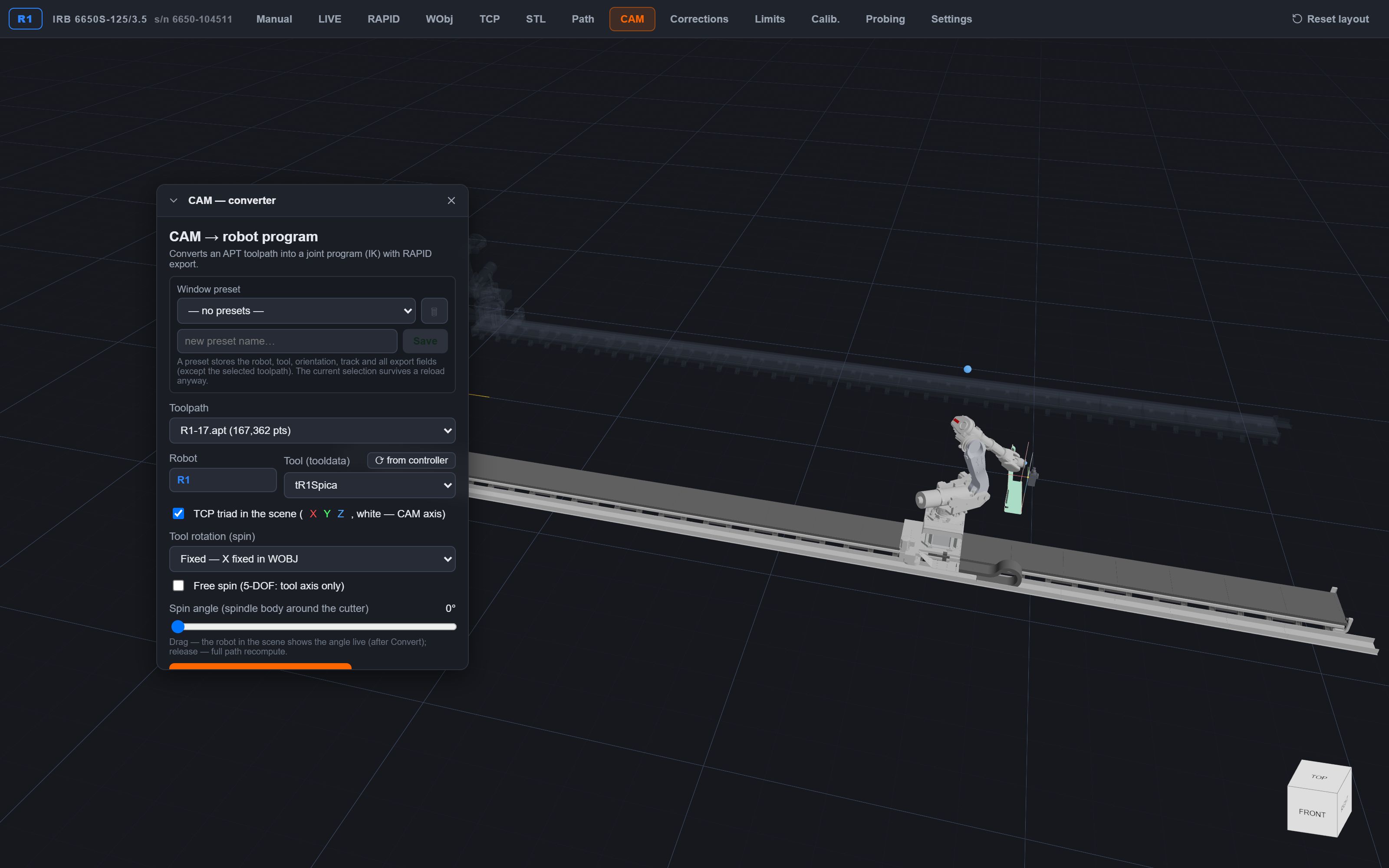
The converter after a solve: 167,362 toolpath points turned into joint motion, the robot placed on the part. Every screenshot on this site is the running application, not a mockup.
Emergency stop sits deliberately outside the token check and does not depend on an internet connection. The application itself runs fully offline — no backend and no bridge required.
Cell scale
More than one robot on the same part
One robot is the ordinary case. The interesting problems start when two arms share a working envelope — and that is where an integrator who installs a single arm usually stops.
1
One robot
Ordinary
Nothing to coordinate, and usually no extra hardware: the bridge to the controller runs on the shop-floor PC itself.
2
Two robots
Proven in production
A shared working envelope, the neighbour present in your scene as a ghost, and a proximity guard that stops both robots without waiting for a person to react. This is the configuration that cell runs in production.
3+
Three or more
Within project scope
Addressing, tenant separation and per-robot state are already N-robot. The proximity guard, however, is pairwise with one neighbour today; making it all-pairs is engineering work that goes into the quote, not into a promise.
Evidence
Built on a working cell, not a demo reel
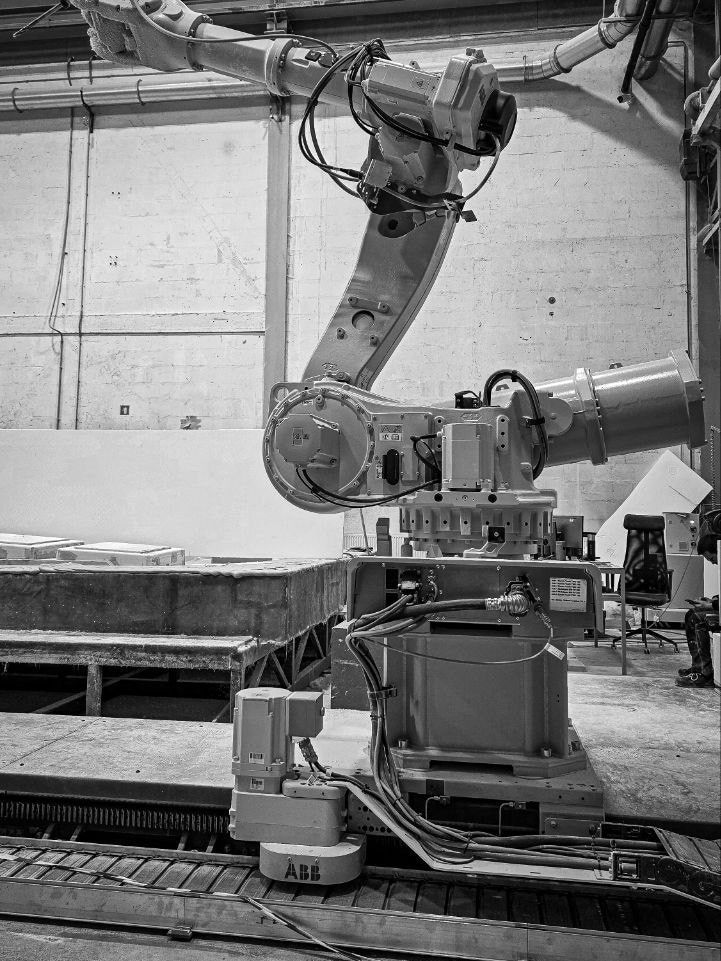
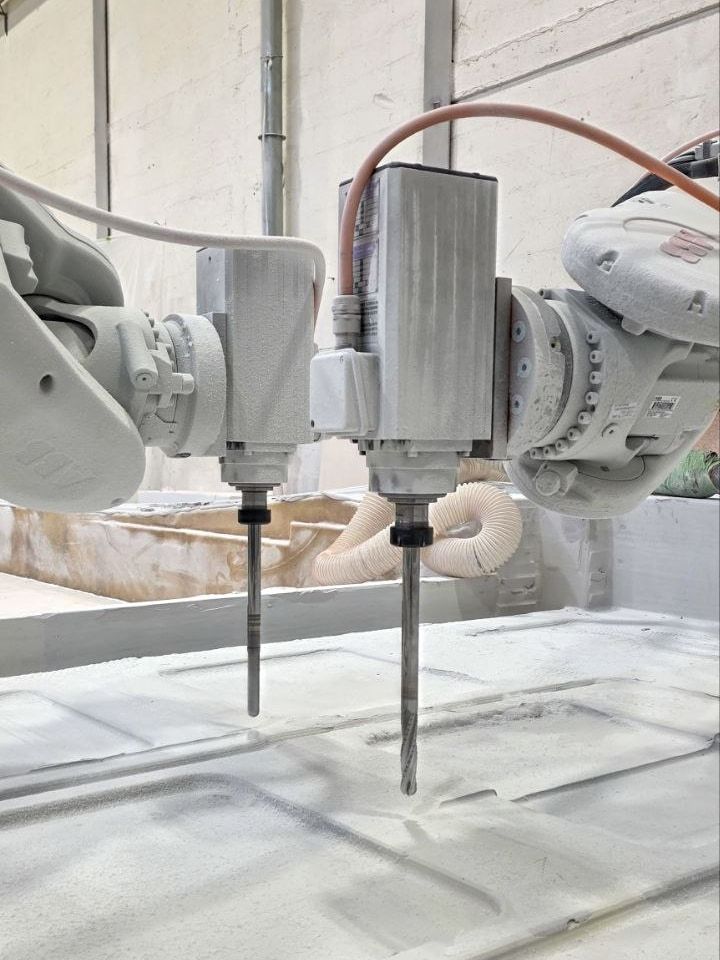
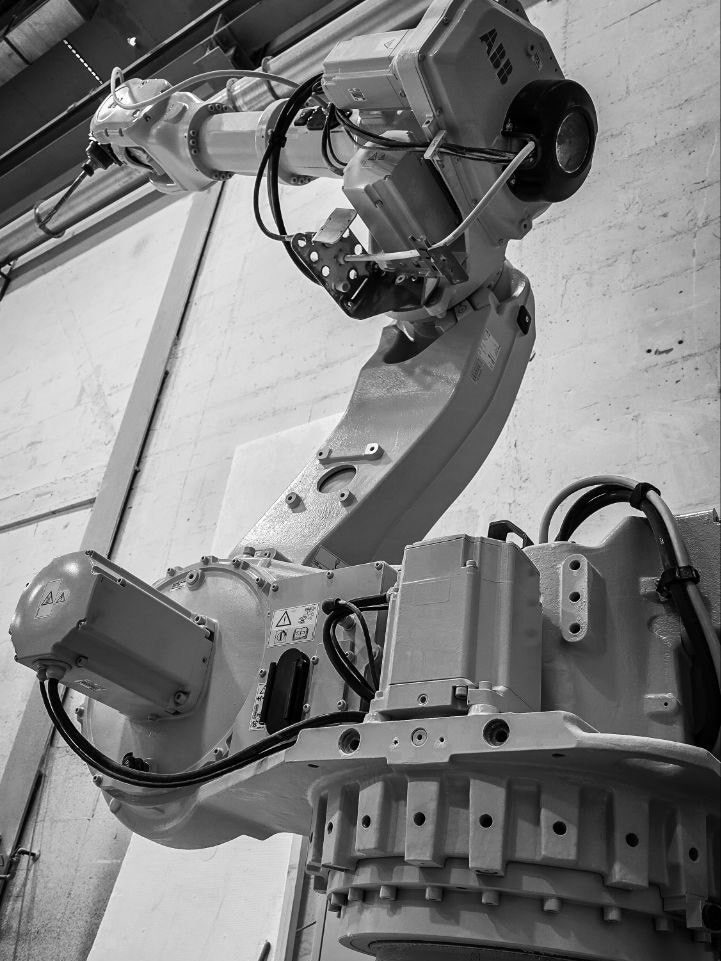
Two ABB IRB 6650S-125/3.5 on 20-metre IRBT 6004 tracks, milling plugs up to 15 metres long. The numbers below come from that cell, not from a benchmark.
The cell all of this was proven on: two IRB 6650S on 20-metre tracks, both working the same part. Three vertical frames rather than one wide shot — the arms stand seven metres apart and do not fit into a single frame together.
13,081,290
points solved on the platform so far — and counting
381
writes to live controllers — every one sealed in a tamper-evident audit chain
A pilot is quoted as one number for one scope: the survey of the job, the whole software side, commissioning on your cell and training for the people who will run it. After that the subscription runs per robot and buys change, not permission — stop paying and the programs on your controller keep running.
There is a line on your side of this that usually gets forgotten: every robot maker sells its own offline-programming suite, licensed per seat and renewed every year — RobotStudio at ABB, its equivalent at every other brand. You still need the vendor tools for controller administration, backups and safety configuration. What you stop buying is a seat for every person who programs a part, because that happens in a browser on any machine on your network. Set our number against those licences plus the engineer who would still have to do the calibration and the post-processor, and it reads very differently.